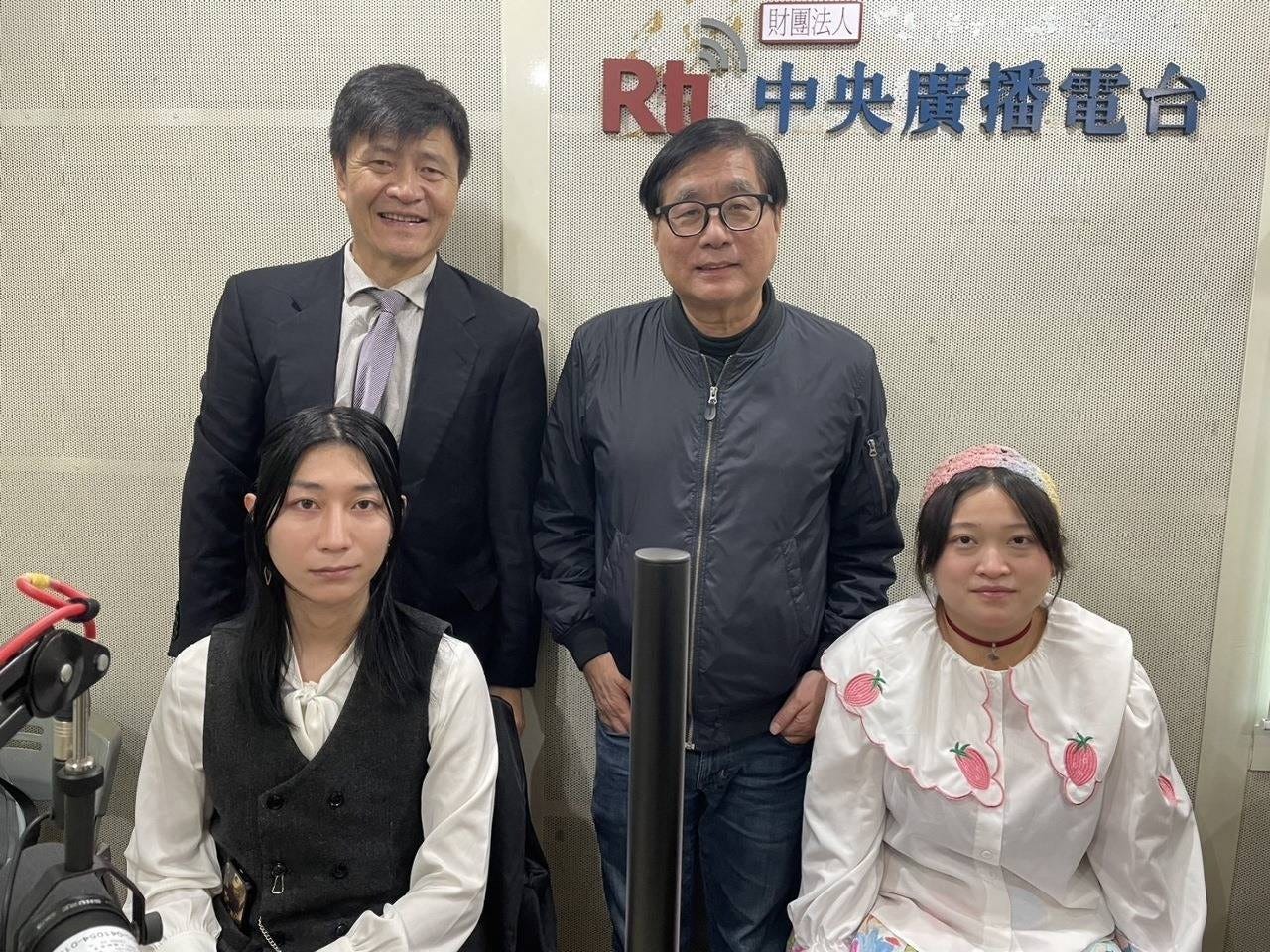
Originally aired January 15, the following interview is a transcript of a radio show, Radio Taiwan International’s “Serve the People,” translated from Chinese to English by HRIC. Host Yang Xianhong interviews HRIC Executive Director Zhou Fengsuo and two young democracy activists who participated in the White Paper Movement on their experiences viewing the elections in Taiwan.
Introduction
Host: Welcome to “Serve the People” hosted by Yang Xianhong! Hello everyone, this is Radio Taiwan International (RTI)’s Voice of Taiwan. The program you are listening to right now is “Serve Our People,” which is on every night from Monday to Friday at 10.30pm. It is also re-broadcast at 12.15am the following day. You can also tune in to our broadcast online at www.rti.org.tw.
For today’s spotlight interview, I will be interviewing three Chinese democracy activists who have come to Taiwan to observe Taiwan’s presidential election. They are Zhou Fengsuo, Executive Director of Human Rights in China; and two young Chinese students studying overseas, Yang Ruohui, founder of the Assembly of Citizens, a youth organization in Toronto, and Apple Ni Peiqing, a participant in the White Paper Movement in London and also a leading member of China Deviants.
Taiwan's presidential and legislative elections were held on January 13, the first of around sixty democratic elections expected to be held in the year 2024. Therefore, this important and determinative election attracted international media attention, with more than 150 media outlets from 30 countries and more than 400 journalists in Taiwan covering the event. In addition, many overseas Chinese democracy activists and media workers came to Taiwan to observe the election.
Democracy and freedom have been the dream of Chinese people since the end of the Qing Dynasty. Following various attempts, after the Republic of China fled to Taiwan in 1949, and after another 38 years of martial law under the “White Terror” one-party dictatorship, we finally found our own path to democracy. In 1996, a comprehensive, democratic system of direct elections was established. The system was implemented and continuously improved, despite constant threats and intimidation from the Chinese Communist Party, for three political party rotations. Today, I would like to interview three overseas Chinese democracy activists to share their insights about the election.
Interview
Host: This is Voice of Taiwan of Radio Taiwan International, you are tuning into the program “Serve the People!” I am the host, Yang Xianhong. In the studio with me, there are three Chinese people who have come to Taiwan to observe the election. One of them is Mr. Zhou Fengsuo (Zhou), Executive Director of HRIC and previously, student leader of the Tiananmen protest movement. Hello, brother Fengsuo.
Zhou: Hello, brother Xianhong.
Host: Our second guest is Yang Ruohui (Yang), founder of Assembly of Citizens, a youth organization in Toronto. Hello, Ruohui.
Yang: Hello.
Host: Thank you for participating in our program. Here we also have Ni Peiqing (Ni), a participant in the A4 Revolution in London. Hello, Peiqing.
Ni: Hello.
Host: Thank you to the three of you for appearing on my program! Is this the first time you’re in Taiwan to observe the elections?
Zhou: As far as myself, I am quite invested [in the elections], this is already my third time attending. In 2020, I was here for the 2020 presidential election, while in 2022 I was here for the local elections.
Host: Is this Ruohui’s first time?
Yang: Yes, my first time.
Ni: My first time too.
Host: Let’s get our listeners to understand your impressions of Taiwan and your experiences here, and reveal if Taiwan now is any different from before. Let’s start with Fengsuo.
Zhou: This time is different from the previous times. In Taiwan, domestically, it is relatively peaceful, but the international community’s attention to this election have far exceeded that of past elections. Furthermore, at a juncture where Taiwan’s democracy is facing challenges, many details of Taiwanese democracy have come to the attention of the international community. For instance, there have been many reposts on Twitter about the final vote-counting procedure. Everyone feels like this process is so transparent, there won’t be any controversy. Under such circumstances, it is hard for any rumors to arise, because any candidate can go to any venue themselves to scrutinize the counting process.
Host: Every candidate will have a chance to scrutinize the votes.
Zhou: This is extremely important, because there are many such problems, especially in the United States, there have been nonstop controversies. Taiwan’s respect of democracy has therefore received widespread acclaim, evidenced by the unprecedent attention of the international community this time.
Host: Yes, the speed of the vote counting was also very fast.
Zhou: Yes, it was very fast and very successful.
Host: Ruohui, what are your thoughts?
Yang: Actually, I have a different opinion about Taiwan in this respect, which is that Taiwanese society is very inclusive. If you take a step back and look at these situations, you will feel as if there are great gaps between various parties, between different groups, and that there are great differences between various ethnic groups. Especially from the perspective of someone overseas, you only see the parties, and the most radical and exciting speeches. However, in Taiwan, what I saw was a completely different situation. I will give you a very simple example: once, I went to a night rally. I was on the subway, and was very surprised—just a few moments before, the atmosphere was very tense with emotions running high, the KMT scolded the DPP, the DPP scolded the KMT, then TPP scolded both parties—but as soon as the event was over, and people started returning to their cars and the subway with some people still wearing KMT hats, some people with DPP mats, some people holding TPP clothes or bags, everybody was still very peaceful. They were not saying they were at the party just now, not talking about what they listened to or watched, and no one started fighting or grabbing each other’s things or starting a conflict. So, I think one key point is that the democratic literacy of the Taiwanese people is indeed very good, because my Taiwanese friends also told me that [if this matter happened 30 years ago], there would definitely be fighting, but now there is actually a very big improvement. This also shows that Taiwan's democracy is also constantly improving, which is something I have never seen before.
Host: Actually, Taiwanese people are all waiting for the outcome, and thinking “I don’t have to talk to you now about who will cry or laugh later”!
Yang: Yes.
Host: There is so much [anticipation]. How about Peiqing?
Ni: First of all, I saw that Taiwan's democracy rating by Freedom House is 78 out of 100, which is a statistic that made me very curious. So, I came to Taiwan this time to see with my own eyes how other people in Chinese-speaking areas vote, and how elections are conducted. The experience of coming to Taiwan to watch the election this time actually exceeded my expectations. There were some details about Taiwan's democracy that I noticed: I observed that everyone in Taiwan can freely participate in politics. The most impressive thing for me was my conversation with the night market owner during the ballot counting process, and my chat with a taxi driver. First of all, I didn't expect that during the ballot counting process, I could be so close, and everyone could really scrutinize the entire process. I saw at the ticket office that every ticket would be shown and read out loud. In fact, this is also a symbol of the voice of democracy, and when every time each vote was read out, I also observed that the Taiwanese people's trust in Taiwan's democracy is very strong, that is, no matter which party wins the election, everyone still respects the results of a democratic vote. For example, once in a taxi, a veteran driver said in the course of our conversation that even if the party he supported did not win the election, he would be disappointed but still support the eventual outcome. Later, before the ballot counting, we were walking in the night market and chatting, and suddenly we talked about TPP’s housing policy. We forgot what the rental policy was, and on a whim asked a stall owner within the night market about it. And he actually replied and told us about it in great detail. This is because the democratic participation of the Taiwanese people is very high, and this really impressed me.
Host: What has been the most worthwhile for you during your participation? Fengsuo?
Zhou: To me, I visited Mr. Lin Yi-Hsiung’s Chilin Memorial House in Wujie.
Host: Ah, in Yilan.
Zhou: I feel that Taiwanese democracy has not come easy, not just because of the struggles and sacrifices, but also that rebuilding could occur under such difficult circumstances. That someone whose entire family was murdered could still practice compassion, kindness, and tolerance—this become the foundation of democracy in Taiwan today.
Host: Ruohui, which activity that you participated in had the most impact on you?
Yang: I think that all the events I participated in in Taiwan were meaningful, because Taiwan is a place full of miracles where many unexpected things can happen. If I really have to point out one event, after much deliberation, it would be the theatrical troupe I saw earlier?
Host: San Yu Shi Theatre?
Yang: San Yu Shi Theatre is kind of like, you tell a story, and then they present your story to you through dance and performance, which in itself a kind of artistic creation, a form of improvisational art. In fact, when I was there, there were a few Chinese friends from the mainland. We were actually quite touched when they brought up the topic of home and hometown. A friend said that he lived overseas, and his name would be mispronounced the other way around, and then if someone called his name properly suddenly from behind his back, he would be super moved because it was like a taste from his hometown, a taste from home, a particular sound. And this sound is really something that is long-lost and elusive for a dissident overseas, especially for a dissident who is participating in activism under their real name. So, in fact, this really aroused our nostalgia. For example, I know that Taiwan used to have a blacklist system, and then there were also many overseas exiles like Hsu Hsin-liang and Peng Weiming. They also said that after unrelenting struggles, they finally took back their country, so what we are actually doing is similar to the Taiwanese democratic movement in the past, that is, we want to take back our own country overseas through our struggle and our efforts.
Host: Save our own country!
Yang: Yes, we save our own country.
Host: Good, what about Peiqing, coming from London?
Ni: First of all, I think one of the most memorable activities for me was when I was at the 228 Memorial Hall. Mr. Chen Qingsheng, a victim from that time, took us to view the park. I was very impressed when Mr. Chen walked to a cell and said that this was his VIP room. He was very optimistic and said that it was actually a cell where he lived at the time, and then he had wanted to commit suicide three times in it. There is really no way to simply describe this experience in words where he took us to where he was actually being held, it felt like a kind of communication through emotions. Then he took us to the monument of the victims, and one by one, he introduced them to us. The names that protruded from the wall signified that they might have been sentenced to death. Between the names that protrude and those that don't, there's a space in between, because they want the sunlight to fall onto the next name. From some of these details, it can be seen that Taiwan attaches great importance to this earlier period of silence and dictatorship, and also attaches great importance to its history, which also highlights the Taiwanese people's and Taiwan’s current belief in democracy. It's a very valuable and important thing. It's also a light in the Chinese-speaking region. So, when I'm in London, when I go about doing these activities, I feel that Taiwan is my hope, and I want to say here that I'm very, very grateful, and I'm very, very pleased that Taiwan can adhere to its democratic policies, especially the voting system and elections. Thank you.
Host: You know that our program on RTI today is broadcasting to China, and your voice has already returned home. We broadcast through a total of 10 channels in North China, Central China, and South China, and this program will be sent out directly and broadcast in the shortwave radio and midwave radio. Hence, it is difficult for the CCP in China not to listen to it, your voice has returned home! I have a question now because Ruohui mentioned Peng Mingmin and Xu Xinliang. There are still many blacklists, and you are obviously also blacklisted now in China. Our radio station is considered to be, I once said, China's underground radio station. When we broadcast to China, the CCP does not allow me to broadcast like this, this is broadcast by force. Yet my program has been, from 2005 to the present, running every single day, no matter under the reign of which political party, I have not ceased my program. The blue camp, Ma Ying-jeou, was in power for eight years, and I was able to keep doing this show for those eight years. I asked President Chen Shui-bian to do this show in 2005. At that time, we said that—because Ruohui just talked about this experience, I imagined: one day you all have to go back, but I am thinking about where you go back from. I think you should go back from Taiwan, and if you need this, Taiwan can provide you with a springboard. So it doesn't matter how you fly, just fly to Taiwan, fly back to China from Taiwan. Like Hsu Hsin-liang, be arrested when you go back, and we will rescue you as soon as you are caught. We have also told the CCP that this will happen one day, and you are ready. Many Chinese friends will return from Taiwan.
Yang: This is really reclaiming the mainland.
Yang: So, what do you think?
Zhou: It’s very good. Every time I am in Taiwan, I love to swim to the edge of the beach, and be very close to the mainland.
Host: You can swim over hugging a basketball.
Zhou: Last year during the White Paper Movement, it was really an emotional situation. I thought that this was a critical time and Taiwan would definitely play an important role. Everything we do overseas is still for China; the real focus is to change the situation of more than a billion people being enslaved on this continent. This is the biggest contribution we can make to the world. In the past two years or so, in fact, the situation has developed rapidly. This time, these two young people can be here, and they represent friends who are very concerned. For someone who has persisted for 35 years, it is very inspiring, that is, that more people are joining us.
Host: Like what Ruohui said earlier, Taiwan’s democracy movement is key. Within Taiwan, there has been a lot of resistance, but we are especially thankful for the attention from democratic countries including the United Kingdom, the Europe Union and the United States. This kind of emphasis is not just a once-off because of the election. When people returned to Taiwan from the States, that broke through the blacklist and was a big jolt to the democratic movement in Taiwan. Ruohui, what do you think?
Yang: Yes, it’s like Mr. Zhou (Fengsuo). I know he once tried it, but didn’t succeed, then tried again…
Zhou: Yes, I did!
Yang: Yes, once.
Zhou: I was repatriated once from Hong Kong. [Another time,] I actually slipped into China, and I was repatriated at Tiananmen Square.
Yang: I think there is still one point, a difference in the situation. Taiwan’s democracy movement after all still has a certain level of support and influence in the United States, so the current situation in China's democracy movement may be different from the situation at that time. If you are like Hsu Hsin-liang and Peng Yongming, it’s fine for you to [slip into China], but if other people try to do the same, the results may be different, such as the previous incident at National Taiwan University.
Host: Yes, Chen Wencheng.
Yang: Yes, after Chen Wencheng, it was…
Zhou: Chen Wencheng was assassinated.
Yang: He was assassinated, but I don’t think he was trying to enter illegally, he just came back normally.
Host: Yes, he came back via the normal way.
Yang: What I am trying to say is, [entering at the border without proper authorization] has its risks. Even if you enter the country via normal means, you can be assassinated, or you can also be repatriated even if you successfully enter. Actually, sneaking in causes a big impact. I remember Hsu Hsin-liang’s incident. He fled after the neutrality incident, but when he came back, he publicly announced that he would be at…was it Songshan airport?
Host: That was Taoyuan Airport.
Yang: Oh, Taoyuan Airport. Let’s say I want to land somewhere, and after I publicly announce it…
Host: Everyone will then surround the airport.
Yang: Later, after he was picked up, he had some conflict with the police. This was interesting and stirred the emotions of many. But I think what we are trying to say is, there are different situations under different regimes, and the structure and methodologies are not the same.
Host: Yes.
Yang: For the Chiang Kai-shek government at that time, if they murdered returnees, or said they might murder the returnees one by one, it would have a great international impact and a lot of international pressure. Not to mention that you want to go to the United States to assassinate American citizens, the big thing about the Jiangnan case, [the assassination of Liu Yiliang, Liu Jiangnan was his pen name,] was that it put them under great international pressure, and Taiwan itself was under great pressure. Taiwan itself is on the front lines, it has always been facing a very real and bitter communist threat. They really needed the help of the whole democratic community, so in such a situation, the government is under international pressure, far beyond that of the current Communist Party. After all, because China is comparatively large with a larger population under its rule, it definitely has a certain level of influence over the international community. As we’ve seen, they can just kill a Nobel Prize winner, and try to kill whoever they want, and do whatever they want…
Host: Liu Xiaobo.
Yang: Yes, that’s why we need a strategy.
Host: But I feel that in the last one or two years, especially after Trump and Biden, the situation has changed. Peiqing, what do you think? Regarding the issue of the blacklist and of returning home.
Ni: First and foremost, returning home has become a false proposition. To me, China is not place where I feel a strong sense of belonging, because I have experienced a lot in China, and I have always felt orphaned in China in a sense. I don’t feel like I really have a home there. It is only after I went to London that I felt like I found my family. My biological family are not really my family, it is the people I found later that are my true family. I am thankful that you talked about how from Taiwan you can illegally enter China. Currently I am overseas primarily for a few activities. For one, I am deeply concerned about international advocacy for the human rights of Chinese citizens and civil society education. When I do all these things, I will often think about how to contact friends in the mainland, and how to raise awareness in the mainland. Right now, we are definitely doing some things and if an opportunity arises and if there is such a need, I think I will go from Taiwan, the shining beacon of the Chinese-speaking world. I want to walk there from this lighthouse, it will be so wonderful.
Zhou: Actually, during the White Paper Movement, their activities in London had a big effect in the mainland, and Peng Lifa’s message was proudly displayed in Trafalgar Square.
Host: Back to this election. I am very curious what you think of the outcome of this election, the percentages, the wins and losses, as well as the legislative election results.
Zhou: I think we are mainly concerned about observing the outcome. I think it’s important that Lai Ching-te and Xiao Meiqin win, because this is the Taiwanese people once again saying no to the CCP regime. This will be a clear message, regardless of the CCP threats, whether it is appeasement. This shows that Taiwanese people are clear and this is the most important message. Another thing is the number of legislators. I think we can see each party’s build, for example TPP’s supporters are very young, their average age is 20 something, but many have brought their children along. What they are feeling is that despite Taiwan’s decent economic development in the past, there are still practical problems, like rental, property prices, and income. I guess this is a response to DPP’s eight years of rule that there could be better policies in these areas. I am happy to hear Lai Ching-te talking about this when he was elected as President. This means that even for those who didn’t vote for him, he also heard their voices and is willing to cooperate with them. This is very good.
Host: Ruohui?
Yang: I agree with Mr. Zhou. Firstly, I want to raise the point that while many people regard Taiwan as the Moscow of this counteroffensive movement against the CCP, this is not quite right. Taiwan on its own is a democratic country, it has its own democratically elected government, it is responsible to its voters, and that is its first priority. Under such circumstances, Taiwan is not really just a base to go against the CCP, it is a place with 23 million people. So, in many cases, because the DPP's anti-communist stance is clearer, many people will be happy when they are elected and feel that we have another victory on the issue of anti-communism. In fact, we also have to see that the other two parties can also achieve some results in the local areas, or gain some votes in the presidential election, and this also reflects some of the wishes and ideas of the Taiwanese people. And then after the election, they said they still have to be united and to stand together because they are Taiwanese. This is one of the things that I am very touched by, that is: “tonight is election night, but after tonight whether you are a blue party, a green party, or a white party, we are all standing together, we are a united country, we are a democratic Taiwan.”
Host: Peiqing?
Ni: I agree. I am very pleased with the results of this election. The winning vote wasn’t over 50%, which means that no matter which party won, and this is the case regardless of country, it creates a democratic process with checks and balances. In this way, this ensures that the ruling party can really think about the problems within Taiwanese society. For the DPP, as I discussed with the taxi driver, some taxi drivers feel that the DPP’s rule for eight years has created some economic issues and some things that people are not happy about. I think that it’s very important that while the DPP was re-elected this time, there are also still voices that challenge the DPP[‘s Lai Ching-te], because this is a democratic phenomenon, that is, different voices exist and can still supervise each other.
Host: What do you think about the CCP’s reaction to this election, that is, that Lai Ching-te cannot represent the mainstream opinion of Taiwan? (laughter) What is your opinion?
Yang: Then does Xi Jinping represent the mainstream?
Zhou: The Taiwanese people have voted and 1 million votes have told CCP that they chose Lai Ching-te as their president.
Host: He was saying that 60% of people did not vote for Lai, so Lai didn’t get more than 50% of votes.
Zhou: (laughter) yes.
Host: Xi Jinping will say you cannot represent him… (laughter)
Yang: Xi Jinping has 100% of the votes then. He has all the votes.
Ni: Yes, all the votes.
Host: Looks like no one is raising their hands to object.
Ni: There are no objections because all the objective voices have been exterminated, and can’t even vote.
Zhou: In China, not only are there no objecting opinions, even the option to be silent does not exist. This is the present situation of the country now. In a democratic country [like Taiwan], with three political parties, this is actually even better than anticipated.
Host: I think we pay a lot of attention to the CCP’s reaction. It didn’t send in fighter jets or missiles immediately. They only said that [Lai] didn’t represent the entire country’s opinion at 40% of votes, which wasn’t over 50%, so be more humble. They are right, but elections are like that.
Ni: Yes!
Host: Winning by one vote is also a win, so we win. However, we have to understand the dissenters’ voices, this is what the President and Vice-President have both said.
Zhou: This time, while observing the elections, we spoke to many smaller parties, like Obasang [the mothers’ party] or with the Taiwan Nation Alliance, which are very unique organizations that really reflect a Taiwanese sensibility. This reflects the maturity of Taiwan’s civil society, which is very meaningful.
Host: Apologies, due to time constraints… We are very happy today to have Humanitarian China’s founder Zhou Fengsuo all the way from San Francisco, founder of Assembly of Citizens, a youth organization in Toronto, Yang Ruohui, and White Paper Movement participant from London, Apple. Thank you to the three of them, and see you tomorrow when you tune in again!