From Urumqi to Hong Kong, two tragedies have unfolded in a mere three years as a result of systemic failures. Three years ago, on November 24, 2022, Urumqi residents who were trapped in their homes under “Zero COVID” lockdown perished in a fire because they were prevented from escape, resulting in at least ten deaths. This tragedy sparked widespread protests against the Chinese government’s extreme pandemic control policies and ignited the White Paper Movement across dozens of cities nationwide.
Three years later, almost to the day, on November 26, a similar nightmare unfolded at Wang Fuk Court in Tai Po, Hong Kong. As early as September 2024, residents had reported concerns about potentially substandard exterior wall materials, non-fire-resistant protective netting, and flammable foam insulation panels. Officials claimed to have inspected the building but issued no warnings. The fire spread rapidly, causing over 150 deaths and at least 40 missing persons, becoming one of the most significant residential fires in Hong Kong’s history. However, before responsibility was even determined, the Hong Kong government, under the direction of Beijing’s National Security Office in Hong Kong, arrested 24-year-old student Miles Kwan, a member of a group of concerned citizens which had launched an online petition demanding an investigation, and accused him of “using the disaster to disrupt Hong Kong.”
These two tragedies, separated by three years, are eerily similar in their disregard for people’s safety, unwillingness to accept responsibility, and obstruction of public accountability.
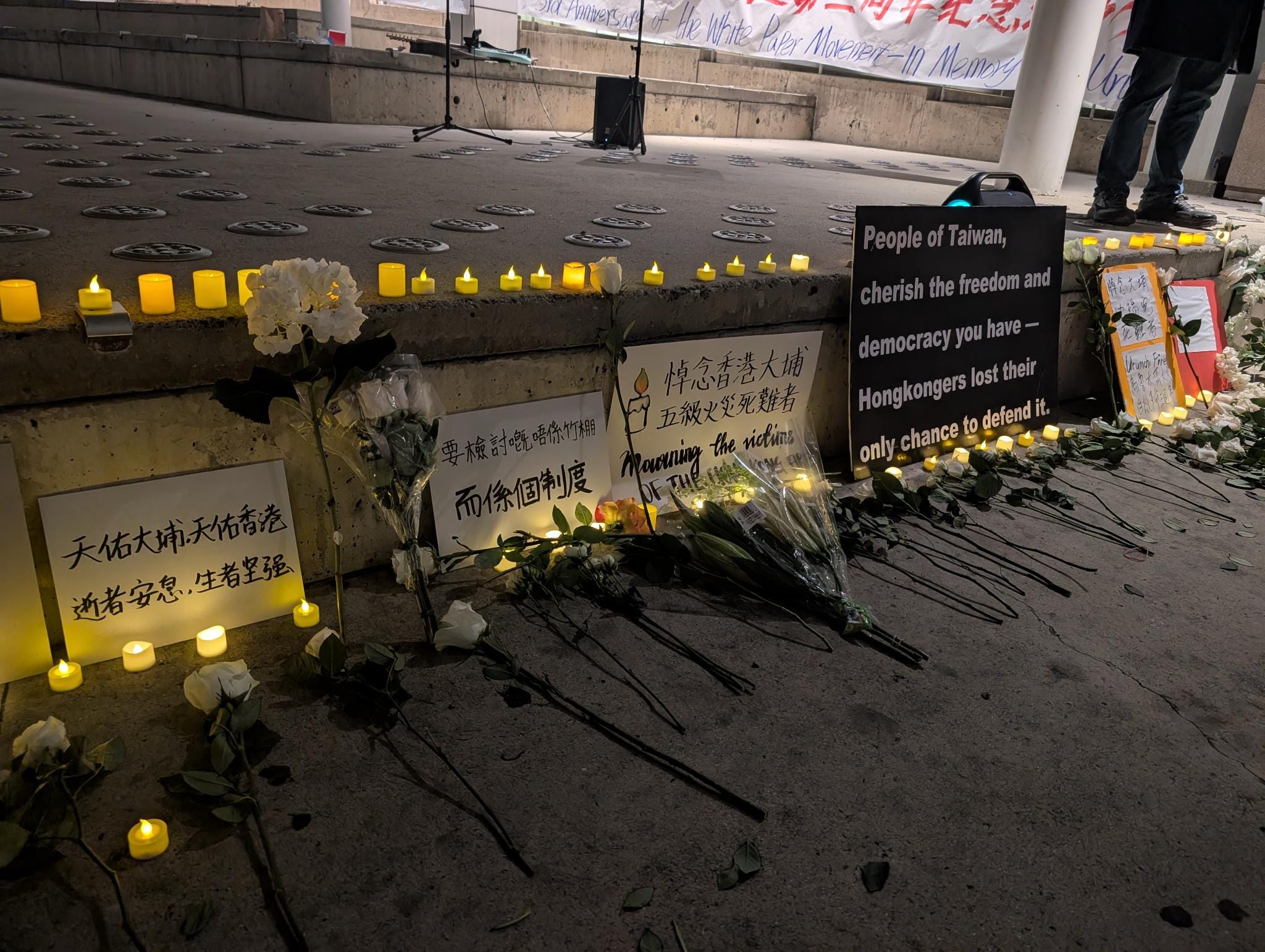
At this critical juncture, the echoes of these tragedies transcended cities and borders, converging in Silicon Valley. On the evening of November 30th, the Bay Area Chinese youth organization Star Shiner and the San Francisco branch of the China Democracy and Human Rights Alliance jointly held a Tai Po Fire Memorial and Third Anniversary of the White Paper Movement event at San Jose City Hall Plaza. The gathering aimed to mourn the victims of the Hong Kong fire and commemorate the movement that erupted in China three years ago.

Cross-Ethnic Connections and Resistance
The event featured electronic candles, flowers, and signs with slogans such as “Remember the Fire” and “No More Lies.” The event began with a minute of silence, followed by a performance of “Wind of Change,” a classic rock song symbolizing the coming of change, by the Star Shiner band. Accompanied by candlelight, the crowd once again held up blank sheets of paper symbolizing the suppression of free speech and collectively read aloud the protest speech “We Are the Orphans of the Square” delivered three years ago by a Chinese student at Columbia University.
Duan Jingji, head of the Star Shiner group, said that the structural similarities between the Urumqi and Tai Po fires lie in the “black box system and lack of accountability.” She emphasized that these disasters transcend political stances and concern the basic safety rights of all people.
Zhou Fengsuo, executive director of Human Rights in China, pointed out that the White Paper Movement was “the largest-scale democratic action in China since the 1989 Tiananmen Square protests,” but that three years later, Hong Kong is experiencing harsh and repressive governance. He mentioned that Hong Kong student Miles Kwan was arrested by the CCP’s national security forces simply for demanding accountability for the fire, stating, “The CCP never solves problems, only eliminates those who raise them.”


Mr. Huang from Hong Kong specially came to the event because one of his students was among the Tai Po victims. He said that exiled Hong Kong people, “though living in free lands, have never ceased to feel sorrow and anger.”
Tenzin Rangdol, a Tibetan, said that Tibetans have been oppressed since 1949, and he hopes that all oppressed groups will unite to fight against the CCP’s tyranny.

Three Years After the White Paper Movement, Some Still Remain Without Freedom
Three years after the White Paper Movement, innocent people still remain in detention for merely participating in protests or expressing their views.
Kamile Wayit is a Uyghur university student who was sentenced to three years in prison simply for sharing a video of the White Paper Movement on social media.
Chen Pinlin was sentenced to three and a half years in prison for producing and sharing the documentary “Urumqi Middle Road.”
Yashar Shohret, a young Uyghur musician, was accused of “gathering a crowd to disrupt social order” for mourning the victims of the Urumqi fire and singing a lament in Uyghur in Wangping Street, Chengdu. He was detained again in 2023 and accused of “promoting extremism.”
For the past three years, images of the White Paper Movement have been deleted from the Chinese internet, slogans have been blocked, and photos have been taken down. However, that awakening was not a fleeting dream, but a collective consciousness that emerged under high pressure, stemming from an awareness of tragedy. Under the shared shadow of the Urumqi and Hong Kong fires, we must demand accountability, or else face the prospect of disaster once again.