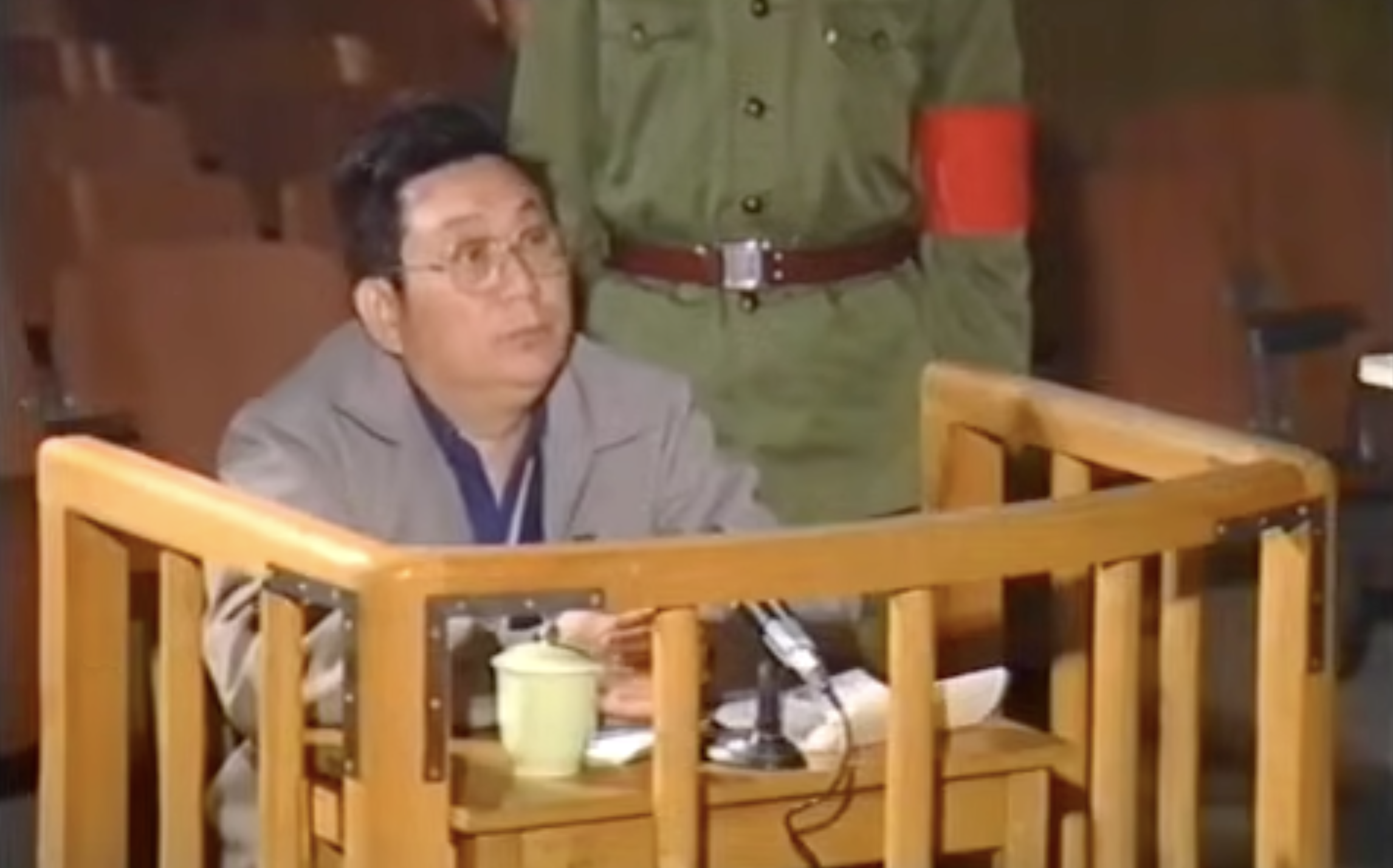
Case of Xu Qinxian: Refusal to Execute Martial Law Orders
Time: 1990
Location: Beijing Military Region Military Court
Defendant: Xu Qinxian
(Former Commander of the PLA 38th Group Army, Major General)
I. Opening of the Trial and Verification of Identity
Presiding Judge:
The court clerk, public prosecutor, and defense counsel are present.
The defendant has been brought into the courtroom.
All preparatory work is complete.
The Beijing Military Region Military Court of the People’s Liberation Army is now in session.
The defendant Xu Qinxian is summoned to appear in court.
(Xu Qinxian enters the courtroom and takes his seat.)
Presiding Judge:
Defendant Xu Qinxian, do you have any other names?
Xu Qinxian:
No.
Presiding Judge:
How old are you this year?
Xu Qinxian:
55.
Presiding Judge:
What year were you born?
Xu Qinxian:
August 1935.
Presiding Judge:
Ethnicity?
Xu Qinxian:
Han.
Presiding Judge:
Place of origin?
Xu Qinxian:
Laizhou, Shandong Province. I was born in Shandong.
Presiding Judge:
Current residence?
Xu Qinxian:
Bajiao, Beijing… (address unclear).
Presiding Judge:
Level of education?
Xu Qinxian:
College level.
Presiding Judge:
When did you enlist in the army?
Xu Qinxian:
December 1950.
Presiding Judge:
What positions have you held since enlistment?
Xu Qinxian:
Cadet, staff officer, company commander, battalion commander, regimental chief of staff, department director, divisional chief of staff, division commander, deputy army commander.
Presiding Judge:
When did you become commander of the 38th Group Army?
Xu Qinxian:
December 1987.
Presiding Judge:
When were you awarded the rank of Major General?
Xu Qinxian:
September 1988.
Presiding Judge:
When were you placed under residential surveillance?
Xu Qinxian:
September 11, 1989.
Presiding Judge:
Where?
Xu Qinxian:
Beijing Garrison Command… (location unclear).
Presiding Judge:
On what charge were you formally arrested?
Xu Qinxian:
January 9, 1990.
The arrest warrant stated: “Refusal to execute martial law orders.”
Presiding Judge:
Where were you detained after arrest?
Xu Qinxian:
Beijing Military Region Detention Center.
Presiding Judge:
Have you received any commendations?
Xu Qinxian:
I received merits and commendations, but I don’t remember the details.
Presiding Judge:
Any disciplinary punishments?
Xu Qinxian:
I don’t clearly remember. I was criticized once for losing a map. I’m not sure if it resulted in formal punishment.
Presiding Judge:
You may be seated.
(Judges’ panel composition and defendant’s legal rights are announced.)
Presiding Judge:
Do you request any recusal?
Xu Qinxian:
No.
II. Court Investigation – Reading of the Indictment
Prosecutor:
This is Indictment No. 1 (1990) of the Beijing Military Region Military Procuratorate.
After investigation, it was determined that at approximately 4:00 p.m. on May 18, 1989, political commissar Liu Zhenhua and other senior leaders conveyed to Xu Qinxian the Central Military Commission’s order directing the 38th Group Army to enter Beijing and carry out martial law duties.
Xu Qinxian explicitly refused to lead the troops into Beijing to execute the martial law mission.
He stated:
“The deployment of troops is a major matter. I suggest this should be discussed by the Standing Committee of the National People’s Congress and the full State Council. Whether this is correct or not must be carefully examined. Such an order should be issued by the state; issuing it in the name of the Party is inappropriate.”
He further stated:
“This action must withstand the judgment of history. In the short term it may not be clear, but history will prove it. Carrying out such a mission may earn merit, or may make one a criminal in history.”
He said:
“Regardless of the weaponry involved, I cannot carry out such a mission. The Central Military Commission may appoint me as army commander, or may remove me. I cannot execute this order. Please appoint someone else.”
Under severe criticism from senior command, Xu Qinxian subsequently went to the operations duty room and relayed the order via secure telephone to Political Commissar Wang Fuyi of the 38th Group Army, stating:
“I do not agree with this approach. I cannot execute the order, and I cannot command. As for who commands, you decide.”
Later that night, Xu telephoned Commissar Liu and stated:
“I have conveyed the order. From now on, do not involve me in this matter again.”
The procurator concludes:
As a senior commander, Xu Qinxian openly defied orders at a critical moment when the Party and state faced grave danger. His actions seriously harmed Party and state interests, with egregious nature and grave consequences. He is charged with Refusal to Execute Martial Law Orders under Article 17 of the Provisional Regulations on Punishing Military Personnel for Dereliction of Duty.
III. Interrogation of the Defendant
Presiding Judge:
You are questioned regarding the facts of your refusal.
(Detailed interrogation follows, preserving all factual content, dialogue, and distinctions between testimony and defendant’s responses.)
Xu repeatedly stated:
“As an individual, I was unwilling to participate.”
“This was different from combat or disaster relief. Civilians and soldiers were mixed together. How could such a task be executed?”
“As a commander, I could not, in good conscience, participate.”
“I conveyed the order, but personally did not execute it.”
IV. Witness Testimonies and Evidence
(Witness testimony from senior officers, aides, and written records is presented.)
Xu acknowledges handwritten notes taken during the meeting, documenting discussions of troop deployment, weaponry, and political characterization of the situation.
V. Discussion of Consequences
Prosecutors cite international media reports describing Xu as having “refused orders” and labeling him a “democratic hero.”
Xu Qinxian:
Due to my own actions, hostile forces and external media took advantage of the situation. I acknowledge this outcome.
VI. Court Debate
Prosecutor’s Closing Argument:
Xu Qinxian’s refusal constituted a serious crime.
Good intentions do not negate the act of defiance.
Transmission of the order under pressure does not absolve responsibility.
Defendant’s Statement:
“I ask whether this was a mistake or a crime, whether it was a matter of thought or a political offense. I believe the court will judge based on the facts.”
(Court debate concludes.)